

 English
 Français
 中文简体
中文简体UAV Pressure Sensor Selection Guide for Drone Altitude, Airspeed & Flight Control
Date:2026-09-24
Content
- 1 What UAV Pressure Sensors Actually Measure
- 2 Five Micro Pressure Sensor Specifications That Matter for Drone Design
- 3 Digital vs Analog Output: Choosing the Interface for Your Flight Controller
- 4 Temperature Drift: The Hidden Cause of Altitude Error
- 5 Packaging, Integration, and Supply Chain Factors for Production UAVs
- 6 Frequently Asked Questions About UAV Pressure Sensors
At 5,000 feet, a 10 hPa barometric error translates into roughly 84 meters of altitude error. For a fixed-wing UAV flying terrain-following missions, that margin is the difference between a clean pass and a controlled crash. UAV pressure sensors are the instruments that tell the flight controller where the aircraft is in the atmosphere, and selecting the right one should be based on measurable specifications, not datasheet marketing.
What UAV Pressure Sensors Actually Measure
UAV pressure sensors deliver three core measurements: barometric altitude, airspeed, and vertical speed. Each measurement requires a different sensor configuration, and separating these functions early in the design process saves months of integration work.
Barometric altitude comes from an absolute pressure sensor. The flight controller converts static port pressure to altitude using a standard atmosphere model. An absolute sensor with a full-scale range of 110 kPa covers sea level to roughly 10,000 meters, which is sufficient for most commercial UAV operations.
Airspeed uses a differential pressure sensor. A pitot tube generates low pressure from forward motion, and the sensor reads the pressure gap between the static port and the pitot tube. The resulting delta-pressure is proportional to the square of airspeed. For drones with cruise speeds below 10 m/s, a micro-pressure sensor with a full-scale range under 1 kPa is essential because the delta-pressure at those speeds is only a few hundred pascals.
Vertical speed is typically derived by differentiating the altitude signal. Some flight controllers combine the pressure sensor with an inertial measurement unit to suppress noise, but the pressure sensor remains the primary data source.
Ground effect detection is another use case. As the UAV approaches the landing surface, the pressure profile beneath the rotor wash changes. A differential sensor with a range of 0 to 0.5 kPa and a fast response time provides the data needed for a smooth touch-down algorithm.
| Function | Sensor type | Typical range | Output format | Critical spec |
| Barometric altitude | Absolute | 30 to 110 kPa | Digital I2C | Low long-term drift |
| Airspeed | Differential | 0 to 1 kPa | Analog or digital | Low-range sensitivity |
| Vertical speed | Absolute | 30 to 110 kPa | Digital | Low noise density |
| Ground effect detection | Differential | 0 to 0.5 kPa | Analog | Fast response time |
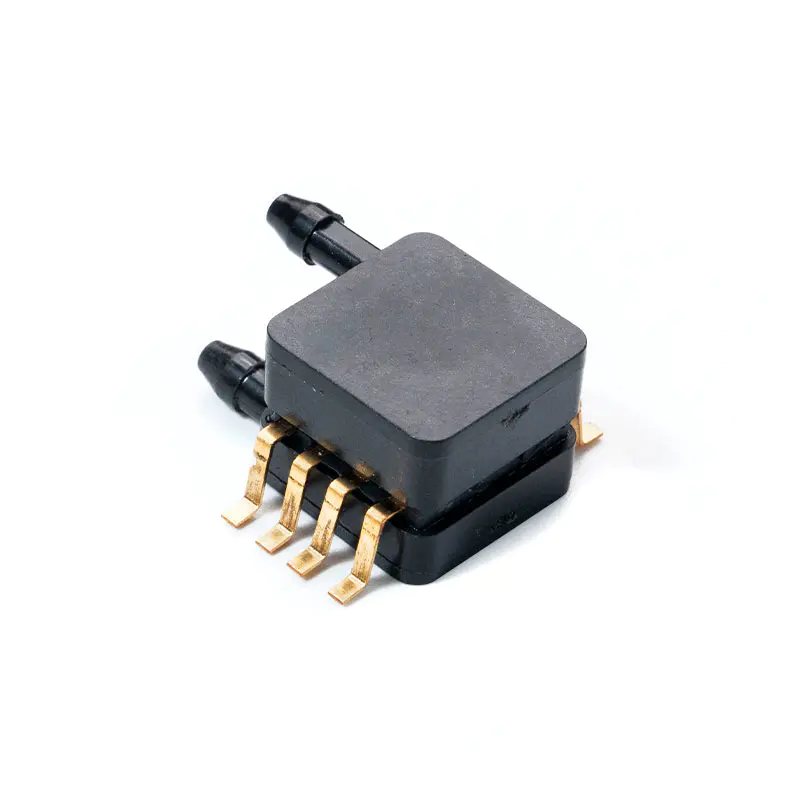
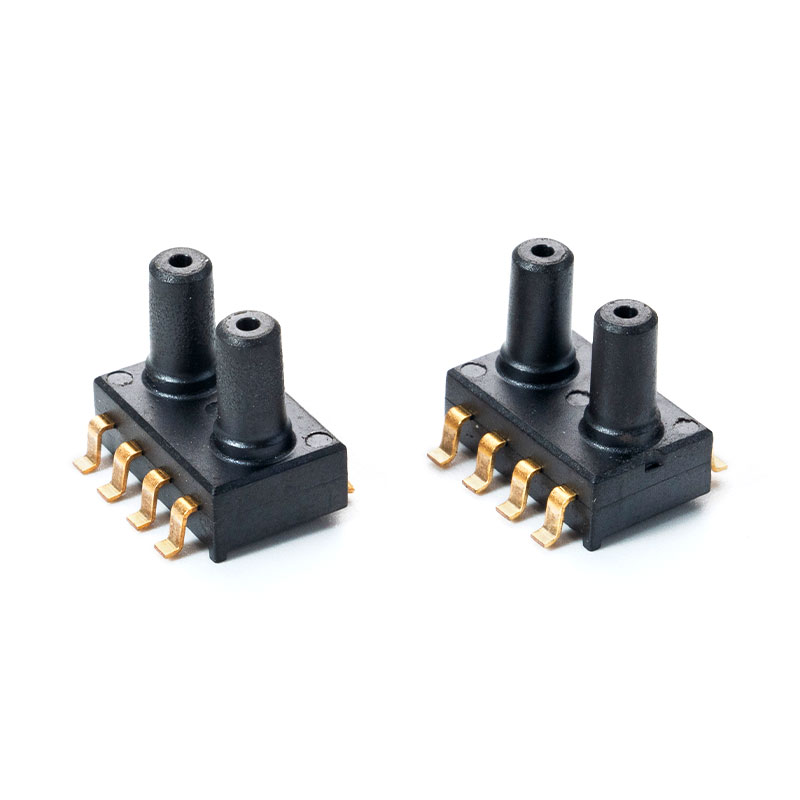 MCP-H21 Pressure sensor for dronesDescriptions The MCP-H21 series is a small-sized package (SOP) with dual ports, which integrates signal amplification, nonlinearity, and temperature compensation for s...View Product →
Five Micro Pressure Sensor Specifications That Matter for Drone Design
Five specifications determine whether a pressure sensor truly works for a drone: measurement range, accuracy, output format, package, and thermal stability. Lock these five values before starting the PCB layout.
- Measurement range - For altitude, the absolute range should cover 30 to 110 kPa. For airspeed, the differential range should be sized so the expected flight envelope uses 50 to 70 percent of full scale.
- Accuracy - A 0.2 percent full-scale output spec is sufficient for altitude hold, but the offset error matters more than linearity. A 0.1 percent FSS offset at the base reference produces multiple meters of apparent altitude error.
- Output format - Digital I2C simplifies wiring and removes the compensation algorithm from the flight controller. Analog output remains useful for custom autopilot boards with a high-resolution ADC and a clean analog front-end.
- Package - Surface-mount (SOP) packaging is mandatory for production flight controllers. DIP or SIP packages work for benchtop testing but are rarely used in volume drone assembly.
- Thermal stability - Factory thermal compensation at multiple temperature points is what keeps accuracy stable across the operating envelope.
The differential pressure sensor precision offered by the MemsTech MCPh20 and MCPh21 family is a direct fit for airspeed and ground-effect measurement in multirotor and fixed-wing platforms.
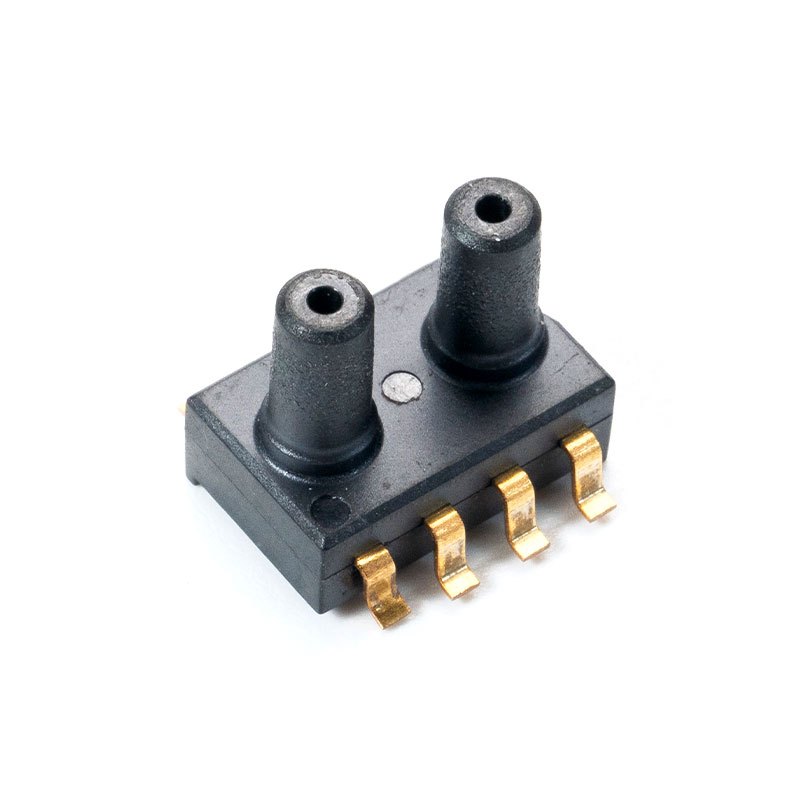
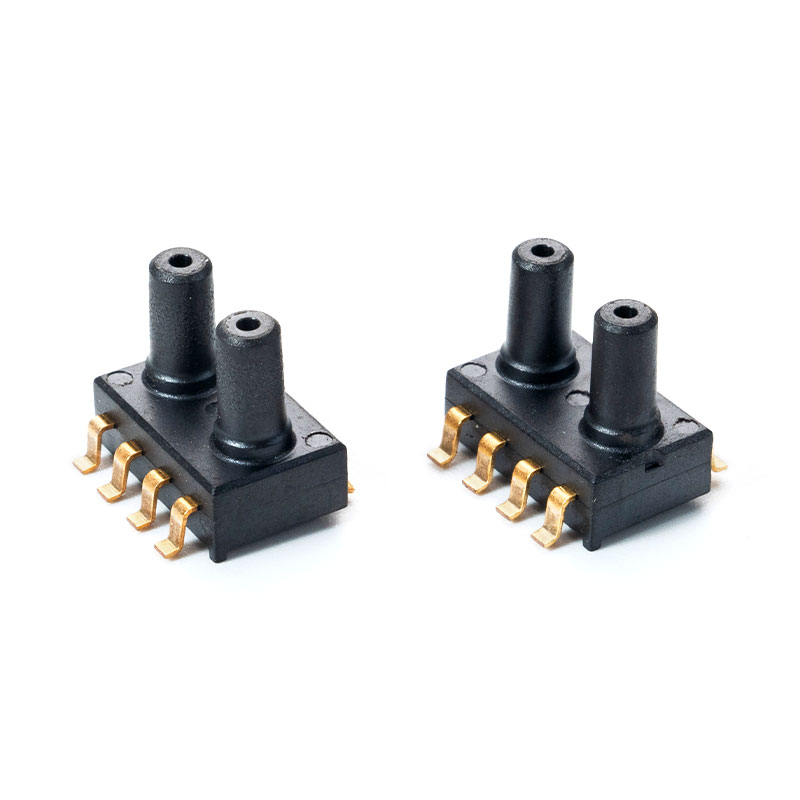 DPT-R8 Micro pressure sensorIntroduction The subject of this document is the functionality characteristics of the differential pressure transmitter based on the Honeywell ABP series pressure sens...View Product →
Digital vs Analog Output: Choosing the Interface for Your Flight Controller
Digital I2C output is now the default for UAV pressure sensors because it moves the calibration workload off the flight controller. Analog output still matters for custom autopilot designs that require raw sensor data.
Digital I2C sensors deliver calibrated pressure and temperature data directly, which reduces processor load and eliminates the need for a precision analog front-end. The flight controller reads compensated values without performing calibration math. This is the simplest path to reliable altitude and airspeed data in a compact UAV flight stack.
Analog sensors output a voltage linearly proportional to pressure. If the autopilot already has a 16-bit ADC with a stable reference voltage, an analog sensor can provide lower latency. However, ESC switching noise from high-current motor drives can corrupt analog pressure readings, especially in multirotor configurations with four or more ESCs. Latency is another differentiator. Digital I2C sensors typically report at 1 kHz, which is fast enough for most flight controllers. Analog sensors have essentially zero protocol latency because the value appears immediately on the output pin.
- Digital I2C - Two-wire bus, built-in temperature compensation, lower EMI sensitivity, simpler wiring in compact stacks.
- Analog voltage - Single output pin, requires external ADC, full control over the calibration curve, lower component cost for simple designs.
Temperature Drift: The Hidden Cause of Altitude Error
Temperature drift, not the sensor die itself, is the leading cause of barometric altitude error in UAV systems. Air temperature drops approximately 6.5 degrees Celsius per 1,000 meters of climb, and the sensor's zero-point offset shifts as the package temperature changes.
Without compensation, a 10-degree Celsius swing can shift the offset enough to produce tens of meters of apparent altitude error. Factory calibration solves this by performing zero-point and full-scale compensation at cold and hot temperature points, then verifying the stability over a long soak period.
MemsTech applies this process to every product before shipment, which is why the 0.2 percent FSS specification holds in real flight conditions rather than just on paper.
Packaging, Integration, and Supply Chain Factors for Production UAVs
Surface-mount packaging is the deciding factor for volume drone manufacturing. The SOP package supports automatic pick-and-place, reduces board area, and eliminates the board-through-hole soldering step that slows down DIP assembly.
For production volumes above 10,000 units, the packaging choice directly affects assembly yield and cost. DIP and SIP packages remain useful for bench prototyping, but they add cycle time and manual labor to the production line. A sensor designed for surface mount, like the MCPV5xxx series, integrates seamlessly with modern reflow soldering profiles.
When sourcing sensors for production, the supplier's in-house capabilities matter as much as the datasheet. MemsTech performs packaging, wire bonding, welding, temperature compensation, calibration, and drift testing internally across a 2,000-square-meter standardized facility. This means the batch-to-batch consistency does not depend on an external subcontractor.
The practical implication is simple: a manufacturing-focused supplier produces more consistent UAV sensors than a trading company that sources from multiple foundries. For a detailed technical breakdown, refer to this comprehensive guide to MEMS pressure sensor technology.
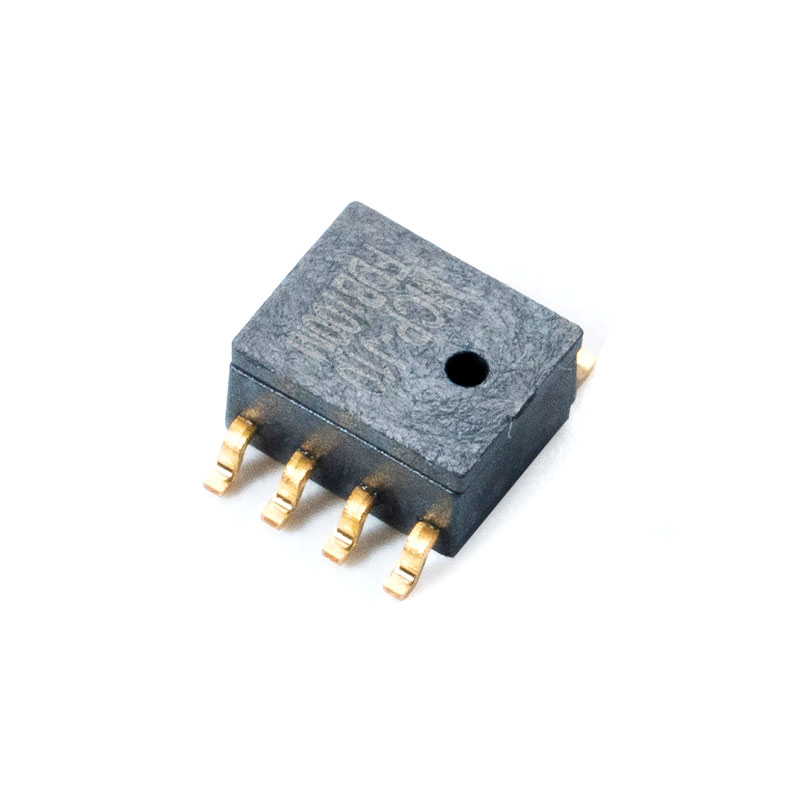
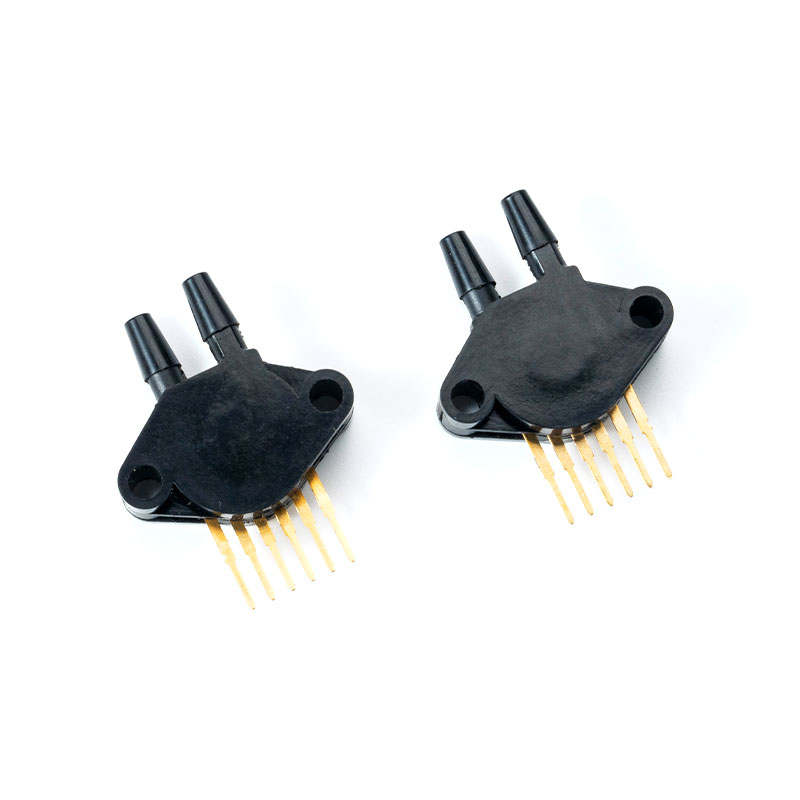 MCP5700DP Pressure sensor for industrialThe MCP5XXXDP series has an integrated silicon pressure sensor Signal conditioning, temperature compensation, and calibrationView Product →
Frequently Asked Questions About UAV Pressure Sensors
What pressure sensor range should I choose for a UAV altimeter?
Choose an absolute pressure sensor with a range that covers the entire operating altitude window. A 30 to 110 kPa sensor covers sea level to approximately 10,000 meters. If the drone flies below 6,000 meters, a narrower 30 to 90 kPa range provides better resolution.
Should I use a digital or analog pressure sensor for a drone?
Use a digital I2C sensor for most flight controllers because calibrated data reduces processor load and simplifies wiring. Choose analog output only if the autopilot has a high-resolution ADC and the noise budget allows for an analog front-end near the sensor.
What is the accuracy of the MemsTech MCPh21 pressure sensor?
The MCPh21 is rated at 0.2 percent full-scale output accuracy. It is a digital output sensor with I2C compatibility, suitable for barometric altitude and airspeed measurements in compact UAV systems.
Can the same pressure sensor measure both altitude and airspeed?
A single absolute pressure sensor handles altitude, but airspeed requires a differential pressure configuration. Some UAV designs use two sensors: one absolute sensor for altitude and one differential sensor for pitot-tube airspeed measurement.

Mems Tech has specialized in the field of pressure sensors for over 14 years.
-
 [email protected]
-
 +86-18068257393
-
 50-1125 Zhongbang City Garden, No.2008 Taihu East Avenue, Xinwu District, Wuxi City, Jiangsu Province, China
Copyright © 2025 byWuxi Mems Tech Co., Ltd. Rights Reserved.
Custom MEMS Pressure Sensor Manufacturers
