

 English
 Français
 中文简体
中文简体High-Accuracy Pressure Sensors for Medical Device Applications | MemsTech
Date:2026-09-09
Content
- 1 What High Accuracy Really Means in Medical Pressure Sensing
- 2 Core Specifications for High-Accuracy Pressure Sensors in Medical Device Applications
- 3 Absolute, Gauge, or Differential: Choosing the Pressure Reference
- 4 Packaging and Signal Output for Medical Device Integration
- 5 Calibration, Temperature Compensation, and Batch Consistency
- 6 Qualification and Procurement of High-Accuracy Pressure Sensors for Medical Device Manufacturers
- 7 Frequently Asked Questions
- 7.1 What accuracy can I expect from a MEMS pressure sensor for medical devices?
- 7.2 How does temperature compensation work in MEMS pressure sensors?
- 7.3 What is the difference between gauge and differential pressure sensors in medical devices?
- 7.4 Can MemsTech support custom calibration and packaging for a specialized medical design?
In a neonatal ventilator, a pressure sensor with 2% total error can alter the delivered tidal volume by 15 mL per breath on a 4 kg infant - a variation directly tied to ventilation-induced lung injury risk. This is why high-accuracy pressure sensors for medical device applications are specified as safety-critical components, not convenience upgrades.
For medical device manufacturers working with Mems - Wuxi Mems Tech Co., Ltd. (MemsTech), sensor selection is never only about the initial purchase price. It is about whether the sensor holds its accuracy across the operating temperature range, survives the clean-room assembly process, and stays consistent across production batches.
What High Accuracy Really Means in Medical Pressure Sensing
High accuracy in a medical pressure sensor means the total error band holds a specified window across the compensated temperature range, not just the nonlinearity at room temperature.
Many datasheets quote accuracy as a percentage of full-scale span at 25 C. That number is useful for bench work but not enough for a device that must perform at patient temperature, during transport, and through repeated sterilization cycles. The usable accuracy is the worst case from nonlinearity, hysteresis, zero offset, span error, thermal drift, and long-term stability.
- Nonlinearity and hysteresis define the deviation from an ideal linear curve after calibration.
- Zero offset and span errors set the absolute reference between 0% and 100% of range.
- Thermal drift describes the shift in zero and span across the compensated temperature band.
- Long-term stability measures the output drift per year under continuous excitation.
For a broader view of MEMS sensor technology and its applications, read our MEMS pressure sensor guide.
Core Specifications for High-Accuracy Pressure Sensors in Medical Device Applications
Four specifications determine whether a MEMS pressure sensor can be used in a medical device: total error band, long-term stability, thermal hysteresis, and media compatibility.
For infusion pumps, anesthesia machines, and ventilators, these values are read together. A sensor with excellent linearity but poor thermal hysteresis will produce different readings at the start and end of a therapy session if the device warms up during use.
| Specification | Medical-grade target | Why it matters |
| Total error band | up to 0.5% FSS | Defines worst-case reading accuracy over temperature |
| Long-term stability | up to 0.1% FSS per year | Reduces recalibration frequency in field use |
| Thermal hysteresis | up to 0.2% FSS | Prevents reading shifts after temperature cycling |
| Media compatibility | ISO 10993 compliant wetted materials | Ensures no reaction with drug or blood contact |
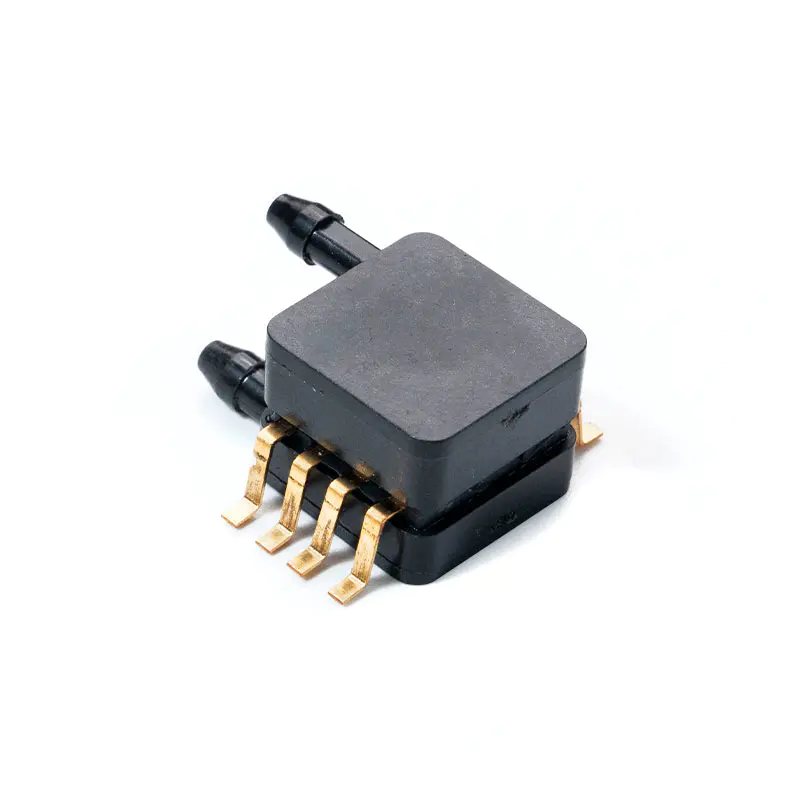
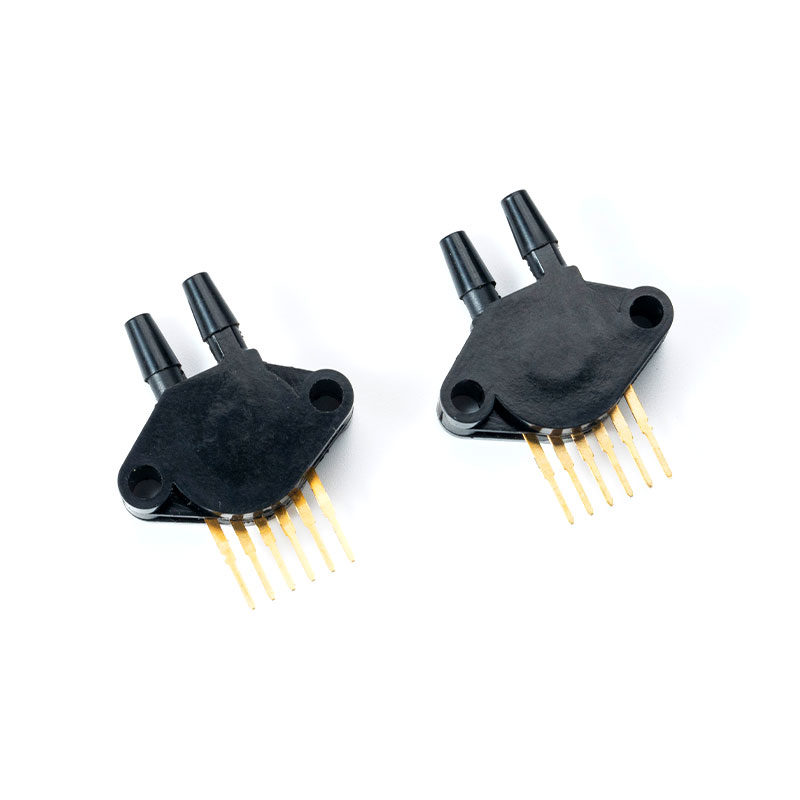 MCP5XXX Series Pressure Sensor for Medical ApplicationsThe MCP5XXX series offers a cased sensor with analog output, calibrated and temperature-compensated, suitable for respiratory and infusion systems where thermal hysteresis must be minimized.View Product →
The MCP5xxx series at MemsTech is a flexible platform for medical OEMs that need a compact cased sensor with either analog or digital output, covering the full accuracy requirements of respiratory and infusion systems.
Absolute, Gauge, or Differential: Choosing the Pressure Reference
The pressure reference type in a medical device determines which physiological measurement you can make, because the reference becomes the zero point of your clinical data.
Pressure sensors are classified by their reference: absolute, gauge, or differential. Each creates a different measurement basis, so the choice is not interchangeable.
Absolute
Reference is a sealed vacuum. Used for barometric compensation in oxygen concentrators and altitude-sensitive devices.
Gauge
Reference is ambient atmosphere. Used in infusion pumps, blood pressure monitors, and dialysis machines.
Differential
Reference is a second input port. Used in respiratory flow meters, anesthesia gas delivery, and filter monitoring.
MemsTech offers all three reference types, with the MCPh and MCPV series supporting absolute-derived gauge and differential measurements for medical applications. Selecting the correct reference is a clinical decision, not a hardware preference.
Packaging and Signal Output for Medical Device Integration
The package and output signal of a pressure sensor directly affect your PCB assembly yield, electromagnetic noise margin, and calibration workflow.
Surface-mount SOP packages are well suited for high-volume SMT assembly on small medical PCBs. Direct-plug DIP/SIP packages provide easier socketing during prototype validation and field service.
- SOP (surface mount) allows pick-and-place assembly and reduces board height in handheld devices.
- DIP/SIP (direct plug) supports manual soldering, socket connections, and lower initial tooling cost in early samples.
Analog output
Continuous voltage or current. Simplest to interface with an ADC but susceptible to EMI if layout is not careful.
Digital output
I2C or SPI with on-chip temperature compensation. Reduces noise coupling and allows direct calibration data to the host controller.
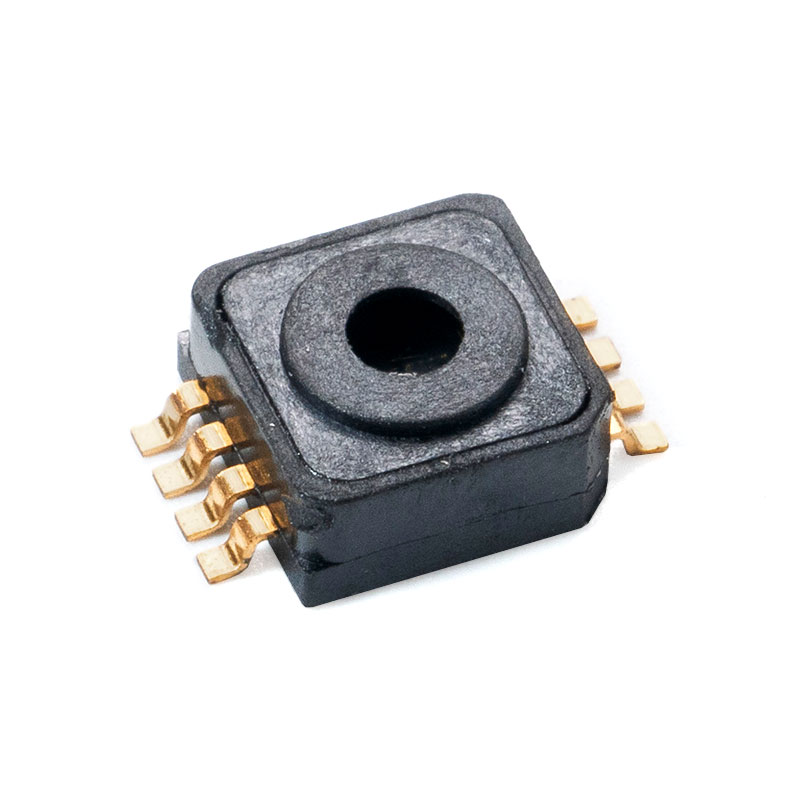
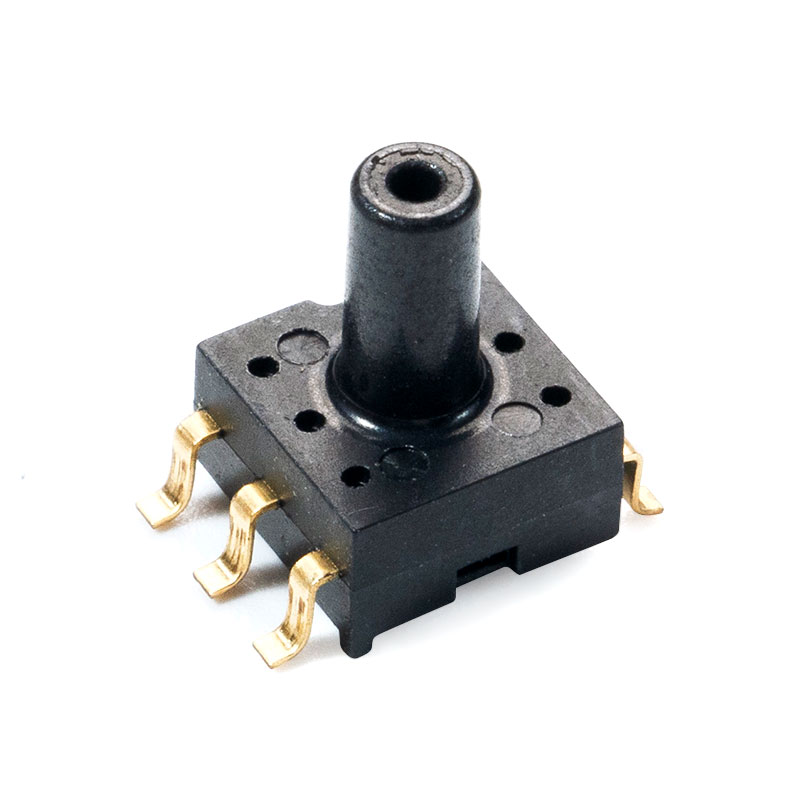 MCP-H10 and MCP-H11 Compact Pressure Sensors for Medical UseThese SOP-packaged sensors provide analog or digital output with onboard compensation, making them ideal for space-constrained infusion and diagnostic devices.View Product →
The MCPh10 and MCPh11 series from MemsTech offer both analog and digital signal options with SOP packaging, making them useful companions for infusion and diagnostic systems where space is limited.
Calibration, Temperature Compensation, and Batch Consistency
Every high-accuracy medical pressure sensor must be individually calibrated at zero and full scale, then temperature-compensated across its operating range, before it leaves the factory.
The calibration process is what converts a raw MEMS die into a medical-grade device. MemsTech applies a controlled sequence during production to ensure each sensor meets the specification on the datasheet.
- Zero and span calibration against a traceable pressure standard at reference temperature.
- Thermal cycling through the compensated temperature range to capture drift data.
- Correction coefficients stored internally, either after laser trimming or digital compensation.
- Stability sampling and lot traceability records for each production batch.
Qualification and Procurement of High-Accuracy Pressure Sensors for Medical Device Manufacturers
Before approving a pressure sensor for a medical device, validate five areas: accuracy over temperature, media compatibility, stability, manufacturability, and supply consistency.
These five checks prevent a sensor from becoming the limiting factor in a device's regulatory submission or field reliability record.
- Request a total-error-band datasheet over your operating temperature range, not a 25 C snapshot.
- Confirm wetted materials are compatible with the fluid or gas and with your sterilization method.
- Review long-term stability data from at least 1,000 hours of continuous run sampling.
- Validate the package footprint against your automated assembly process.
- Ask about batch-traceable calibration records and whether every sensor ships with its own calibration data.
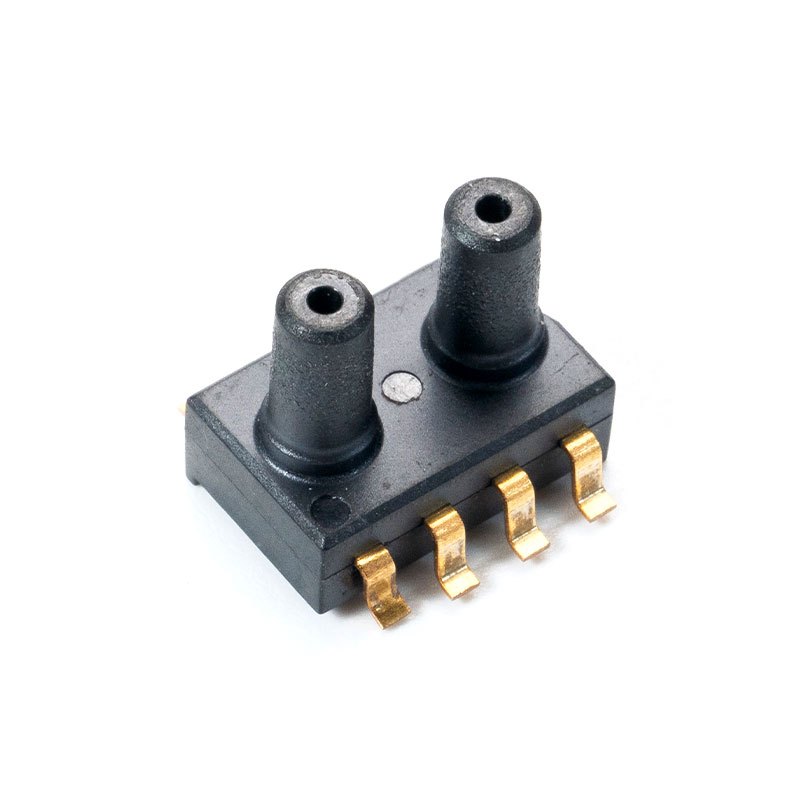
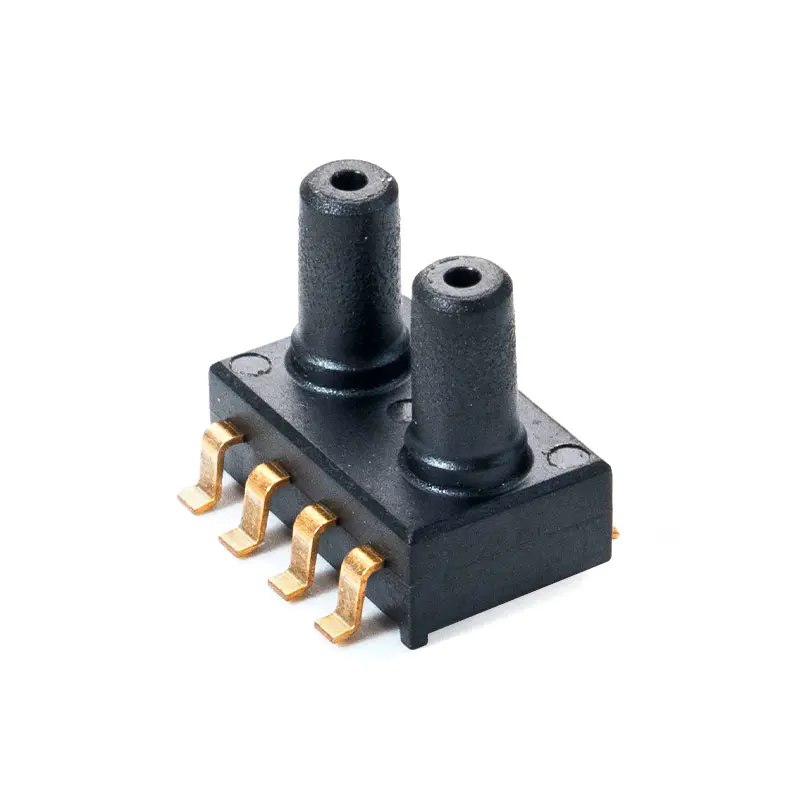 MCP-H20 and MCP-H21 Dual-Port Pressure Sensors for Medical SystemsDesigned for low-pressure gauge or differential measurements, these sensors deliver high accuracy and compact size for respiratory and anesthesia equipment.View Product →
For OEMs that require a low-pressure gauge or differential measurement in respiratory and anesthesia equipment, the MCPh20 and MCPh21 series from MemsTech delivers high accuracy in a compact package.
Frequently Asked Questions
These are the questions medical device engineers and procurement teams most often ask when evaluating high-accuracy pressure sensors for medical device applications.
What accuracy can I expect from a MEMS pressure sensor for medical devices?
Medical-grade MEMS pressure sensors from MemsTech are available with accuracy up to 0.2% FSS. The total error band, not just nonlinearity, is maintained across the compensated temperature range and should be matched to the clinical performance target of your device.
How does temperature compensation work in MEMS pressure sensors?
During production, each sensor is cycled through its operating temperature range. The measured zero and span deviations are used to calculate correction coefficients, which are then stored in internal memory or applied by a signal-conditioning circuit so the output stays accurate across the full temperature range.
What is the difference between gauge and differential pressure sensors in medical devices?
A gauge sensor measures pressure relative to ambient atmospheric pressure. A differential sensor measures the difference between two ports. Respiratory equipment typically uses differential sensors for flow measurement and gauge sensors for line pressure monitoring.
Can MemsTech support custom calibration and packaging for a specialized medical design?
Yes. Mems - Wuxi Mems Tech Co., Ltd. supports customized calibration, packaging, and application development for medical OEMs. The internal facility covers packaging, welding, temperature compensation, and performance calibration from prototype through mass production.
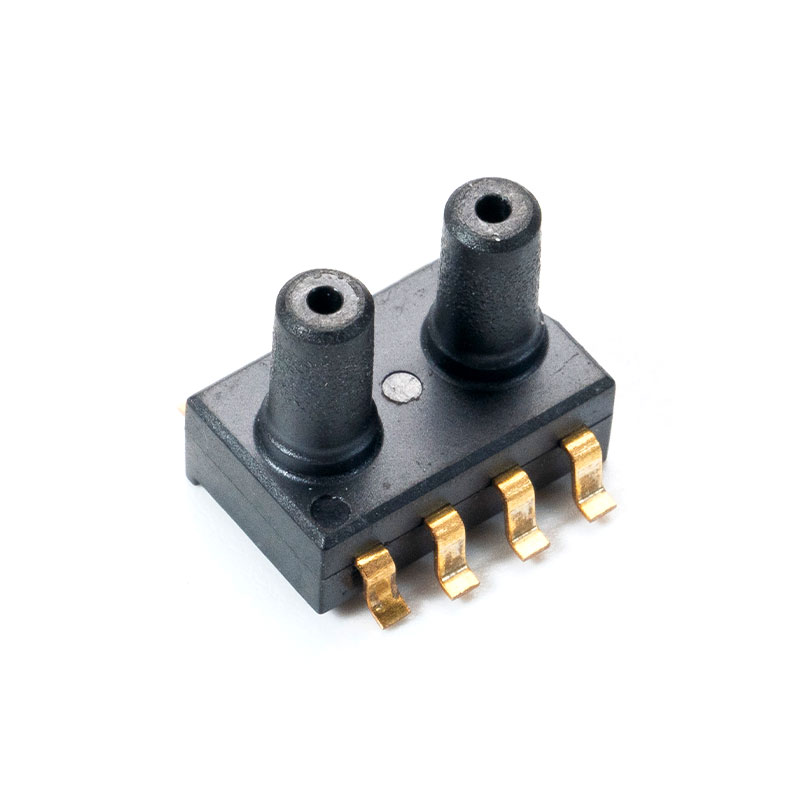

Mems Tech has specialized in the field of pressure sensors for over 14 years.
-
 [email protected]
-
 +86-18068257393
-
 50-1125 Zhongbang City Garden, No.2008 Taihu East Avenue, Xinwu District, Wuxi City, Jiangsu Province, China
Copyright © 2025 byWuxi Mems Tech Co., Ltd. Rights Reserved.
Custom MEMS Pressure Sensor Manufacturers
