

 English
 Français
 中文简体
OEM Medical Pressure Sensor Selection Guide for Device Engineers and Buyers
Date:2026-10-30
Content
- 1 What an OEM Medical Pressure Sensor Specification Must Pin Down First
- 2 Pressure Type Comes First: Absolute, Gauge, or Differential
- 3 Analog or Digital Output on an OEM Medical Pressure Sensor
- 4 Where the Error Budget Goes on a 0.2% FSS Sensor
- 5 Supplier Qualification Checklist for Medical Pressure Sensor Sourcing
- 6 From Prototype to 60 Million Units: Volume and Second-Source Math
- 7 Frequently Asked Questions
- 7.1 What is the difference between an OEM medical pressure sensor and a finished pressure transducer?
- 7.2 Do medical pressure sensors need recalibration after sterilization?
- 7.3 How do I choose the measurement range for a medical pressure sensor?
- 7.4 What is often missing from an OEM medical pressure sensor datasheet?
Choosing an OEM medical pressure sensor rarely starts with a datasheet. It starts with a lumen. A 6 French catheter measures 2.0 mm across, and once wall thickness, a guidewire and a fluid channel are subtracted, the sensing element has roughly 1.2 mm of space to work with. That single constraint removes most of the general-purpose pressure sensor market long before accuracy, price or lead time reach the table. For teams building ventilators, infusion pumps, dialysis machines, patient monitors or single-use catheters, the OEM medical pressure sensor decision is really four decisions in sequence: pressure type, measurement range, output signal and supplier qualification. Change that order and you pay for it twice.
What an OEM Medical Pressure Sensor Specification Must Pin Down First
A workable specification is fixed by five parameters in this order: pressure type, measurement range, output signal, package form factor and sterilization exposure.
Definition: an OEM medical pressure sensor is a component-level MEMS device sold to a device manufacturer for integration into its own instrument or disposable. The buyer owns finished-device performance and the regulatory submission; the sensor supplier owns die accuracy, temperature compensation and lot-to-lot consistency.
That split of responsibility is why medical buyers ask different questions than industrial buyers. An industrial integrator can often absorb a one percent error with a firmware offset or a field recalibration every two years. A medical integrator cannot, because the same error has to be explained inside a risk file and defended during an audit.
Four inputs therefore have to be settled before a single sample is ordered:
- The clinical range and the accuracy required at the extremes of that range, not only at 25 degrees C.
- The media touching the sensing port, because blood, saline, respiratory gas and dry air demand different gel and housing materials.
- The sterilization method, since autoclave, ethylene oxide and gamma exposure shift offset by different amounts.
- The mechanical interface, whether that is a barb, a luer fitting, a tube stub or a surface-mount footprint on the control board.
Pressure Type Comes First: Absolute, Gauge, or Differential
Pressure type is the first decision because it defines the internal reference chamber, the calibration procedure and the failure mode you live with for the life of the product.
| Pressure type | Internal reference | Typical medical use | Failure mode if chosen wrongly |
| Absolute | Sealed vacuum cavity | Barometric and altitude compensation in ventilators, sealed fluid paths in diagnostic instruments | Readings move with weather and altitude, so the part can never infer flow or occlusion |
| Gauge | Vented to ambient air | Non-invasive blood pressure cuffs, infusion line pressure, dialysis pressure monitoring | A blocked vent turns the part into a sealed absolute sensor and the offset shifts permanently |
| Differential | Two independent pressure ports | Flow across a pneumotach or orifice, ventilator inspiratory and expiratory channels, transmembrane pressure | Two ports mean two chances for kinked tubing, leaks and fluid ingress |
The engineering consequence is simple. If the clinical value you need is flow, only a differential part will produce it. If the value is pressure relative to atmosphere, a gauge part is the correct and cheaper answer. Absolute parts belong to genuinely sealed references.
Differential parts are where medical projects most often need a custom port geometry, because the two ports must line up with tubing that already exists in the disposable. Suppliers with in-house packaging can modify a port without touching the sensing die, which keeps the validation path short.
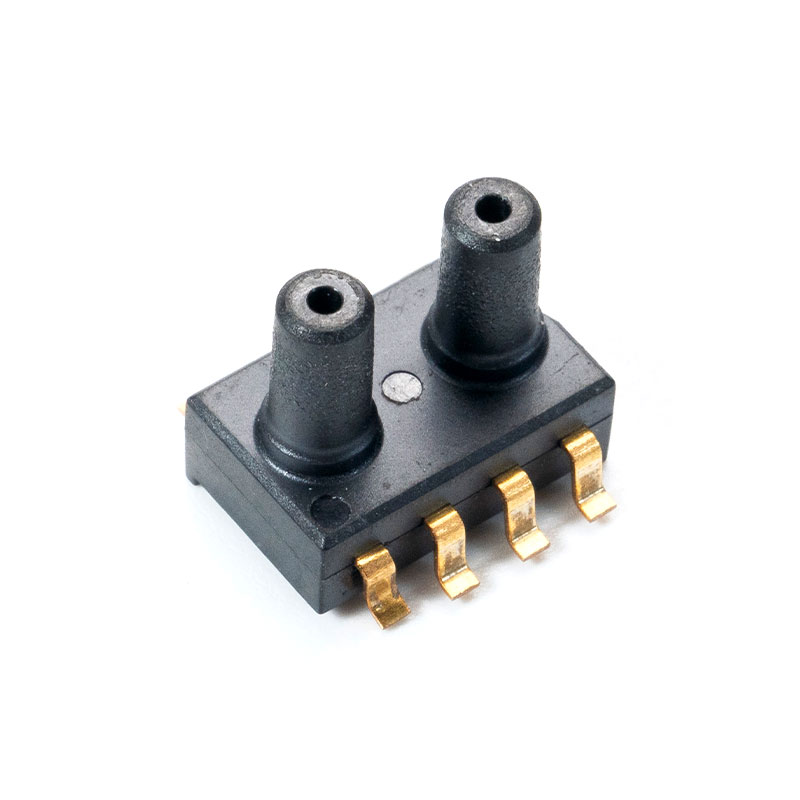
Wuxi Mems Tech Co., Ltd. (MemsTech) organizes its medical line along these same three references. Its MCPh20 and MCPh21 differential family is also listed in the low-pressure and micro-pressure categories, which is normal for a die that serves flow sensing as well as occlusion detection.
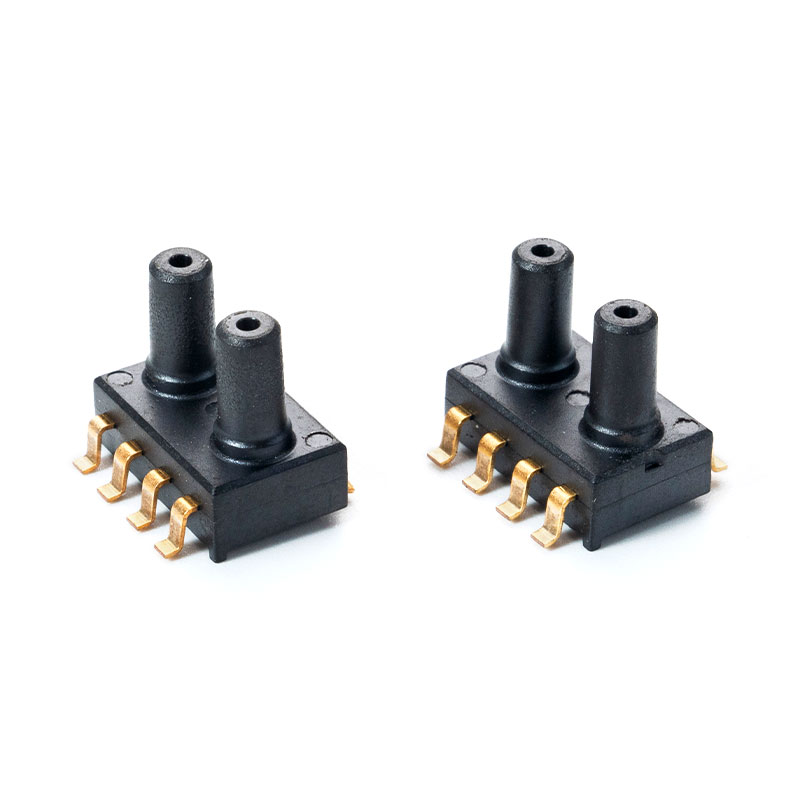 MCP-H20 and MCP-H21 Differential Pressure SensorsAnalog MCP-H20 and digital I²C MCP-H21 options for board-level pressure sensing, with dual ports for medical and flow-detection settings.View Product →
Analog or Digital Output on an OEM Medical Pressure Sensor
Choose digital output when your board has spare microcontroller pins and you want pressure delivered already converted; choose analog when the signal must survive a pump-driven noise environment or drive a hardware comparator with no firmware in the loop.
- Ratiometric 0.5 to 4.5 V or a millivolt-per-volt bridge output
- No protocol, no clock line, no address plan to validate
- Signal path keeps working while the processor is held in reset
- Needs a stable ADC reference to hold stated accuracy
- I2C or SPI, pressure already temperature compensated and scaled
- Fewer analog components and smaller board area
- Averaging and filtering come free in firmware
- Requires a clock, an addressing plan and firmware you must verify
The same sensing die usually appears in both versions, so this is a board-level decision rather than a sensing decision. MemsTech lists analog-conditioned families such as the MCPV5xxx and MCPV7xxx next to digitally conditioned parts, which is the standard pattern for a MEMS supplier: one element, two signal-conditioning paths, two separate qualification tests.
 MCPV5XXX and MCPV7XXX Analog Signal Pressure SensorsAnalog-conditioned piezoresistive transducers for MCU ADC inputs, offered as one sensing element with a separate signal-conditioning path and qualification.View Product →
Whatever you pick, ask for the drift specification of the conditioning circuit, not just the sensor die. A perfect element behind an uncompensated amplifier still fails a 24-hour pump test.
Where the Error Budget Goes on a 0.2% FSS Sensor
A 0.2 percent full-scale accuracy figure is a budget, not a single number, and on a medical-grade MEMS pressure sensor most of that budget is spent on temperature rather than on the silicon itself.
Two conclusions follow. First, a part quoted at 0.2 percent FSS at 25 degrees C says almost nothing about how it behaves at 41 degrees C, which is exactly where a feverish patient or a warmed ventilator circuit sits. Ask for thermal zero shift and thermal span shift as separate numbers across the full clinical range.
Second, long-term stability decides whether the finished device ever needs field recalibration. The underlying MEMS pressure sensor technology sets the floor here, but the practical guarantee comes from testing. MemsTech states that every unit is calibrated for zero and full scale, tested for thermal drift and evaluated for long-term stability before shipment.
The temperature at which a spec sheet stops being theoretical. If a supplier cannot supply drift data above 40 degrees C, your qualification test will discover the number for you.
Supplier Qualification Checklist for Medical Pressure Sensor Sourcing
Qualify a medical pressure sensor supplier on documents, not on samples. A sample proves the part fits today; documentation proves the part will still fit after the next production lot.
- Calibration traceability. Each unit should ship with, or be traceable to, a calibration record referenced to a national standard, because your incoming inspection will be compared against it.
- Thermal compensation data. Request zero shift and span shift over the full clinical range instead of a single room-temperature curve.
- Long-term stability evidence. Drift over an extended soak, expressed as a percentage of full scale per year, is the number that sets field recalibration intervals.
- A written change notification process. A die, gel or housing change forces you to repeat device-level validation, so the notification window matters as much as the specification.
- Capacity and continuity. Confirm annual output, the number of production lines and what happens to your allocation when demand spikes.
MemsTech runs welding, packaging, temperature compensation and calibration in house inside a 2,000 sq m facility and publishes an annual capacity claim of 60 million units. For a buyer, the useful question is not the headline figure but which portion of it is committed to medical lines with medical documentation.
Its OEM medical pressure sensor line for medical devices shows the pattern: the MCP5xxx family sits alongside the MCPh10, MCPh11, MCPh20, MCPh21 and MCPV5xxx families, and the medical category carries more part numbers than any other application category on the site.
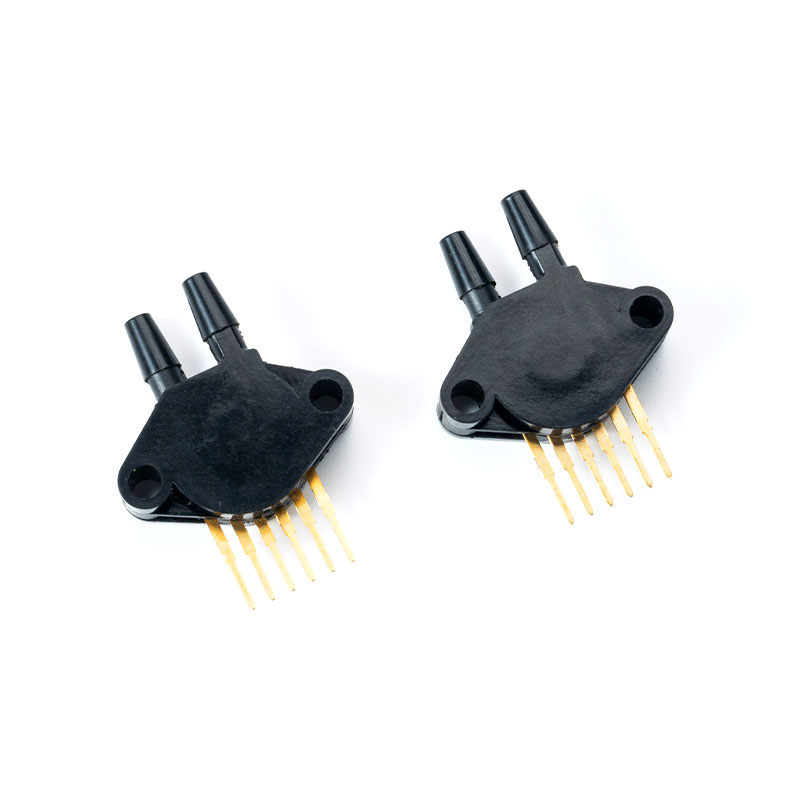 MCP5XXXDP Medical Pressure Sensors for OEM ApplicationsOEM medical pressure sensor family with analog output and configurable absolute, gauge, or differential pressure types for device designs.View Product →
From Prototype to 60 Million Units: Volume and Second-Source Math
Volume sets your unit price, and medical volumes are usually far smaller than the industrial numbers buyers use as a benchmark.
A single medical device model often consumes between 20,000 and 100,000 sensors a year. That is enough to justify a custom calibration, but not enough to command a dedicated line, so a supplier has to schedule your lot between other jobs. Ask for the minimum order quantity, the calibration setup charge and the lot acceptance criteria in writing before the design freeze, not after.
Second-source math usually decides the sourcing strategy. Re-qualifying a replacement sensor means repeating thermal validation, rewriting part of the risk file and possibly filing a regulatory notification. In most medical programs that engineering and documentation effort costs more than the entire annual price difference between two competing quotes, which is why buyers stay with a qualified supplier until the supplier itself becomes the risk.
This is also the argument for choosing a supplier with in-house manufacturing. A company that packages, calibrates and tests on its own line can change a range, a gel or a port geometry without renegotiating with an external foundry, which shortens the path from prototype to production.
Frequently Asked Questions
What is the difference between an OEM medical pressure sensor and a finished pressure transducer?
A finished transducer delivers a calibrated signal in a housing with a defined connector and is treated as an instrument. An OEM medical pressure sensor is a component: the device maker owns the fluid path, the connector, the sterilization process and the regulatory submission. The OEM part costs less and fits smaller spaces, but the integration work and the validation burden move to your team.
Do medical pressure sensors need recalibration after sterilization?
Yes, offset should be re-verified after sterilization, because the thermal and mechanical stress of the cycle moves the diaphragm and the gel. Ethylene oxide is comparatively gentle, while autoclave and gamma exposure are harsher. Ask for pre-sterilization and post-sterilization offset data at 25 degrees C and at the top of the operating range, and keep both curves in the design history file.
How do I choose the measurement range for a medical pressure sensor?
Size the range so the highest pressure the device can legitimately see stays below full scale with margin for alarms, and the normal operating point sits in the upper half of the range so resolution is not wasted. A ventilator channel that normally runs at 40 cm H2O but spikes during a cough needs a range that survives the spike without saturating, and the spike is usually what a clinician tests first.
What is often missing from an OEM medical pressure sensor datasheet?
Thermal zero shift measured over time rather than over one temperature, long-term stability in percent full scale per year, the wetted material list, and the calibration standard that the quoted accuracy references. A datasheet that gives only a single accuracy number at 25 degrees C is a starting point for a conversation, not a specification.
Specify the environment first, the pressure type second, the output third, and treat the accuracy figure as the last item to negotiate rather than the first.
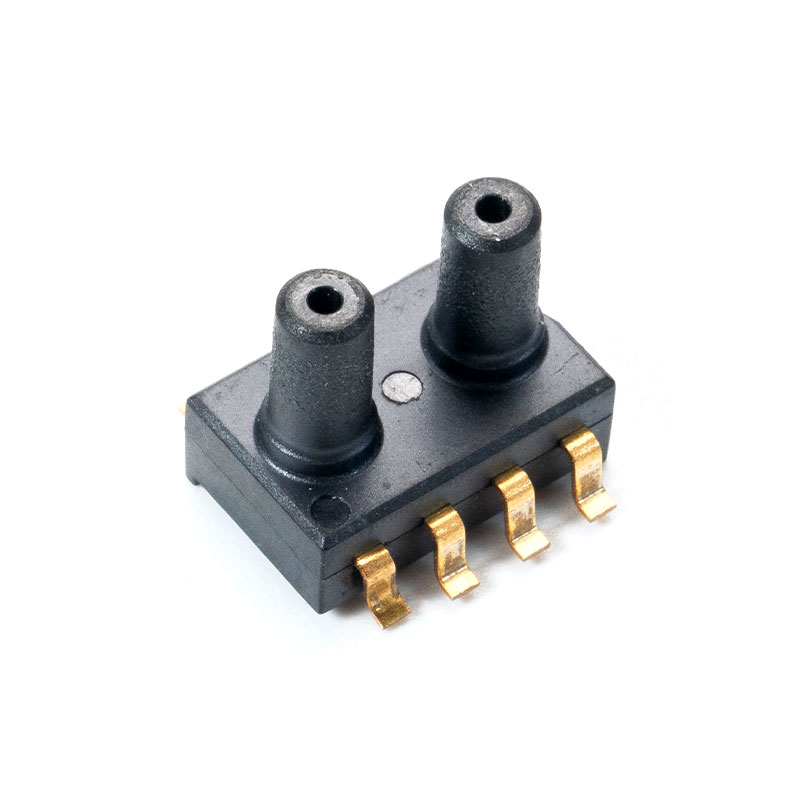
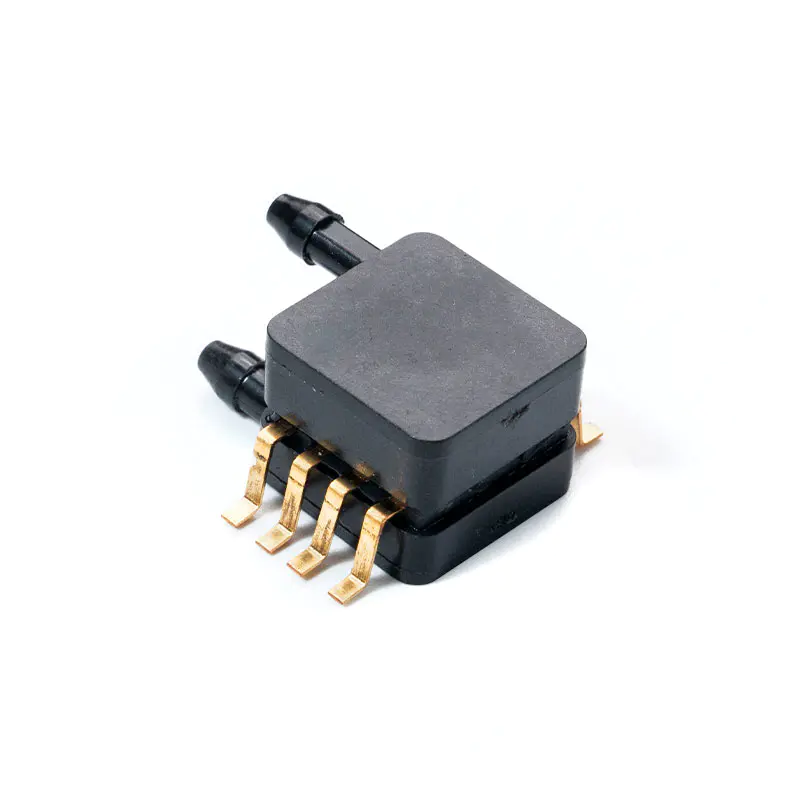

Mems Tech has specialized in the field of pressure sensors for over 14 years.
-
 [email protected]
-
 +86-18068257393
-
 50-1125 Zhongbang City Garden, No.2008 Taihu East Avenue, Xinwu District, Wuxi City, Jiangsu Province, China
Copyright © 2025 byWuxi Mems Tech Co., Ltd. Rights Reserved.
Custom MEMS Pressure Sensor Manufacturers
