

 English
 Français
 中文简体
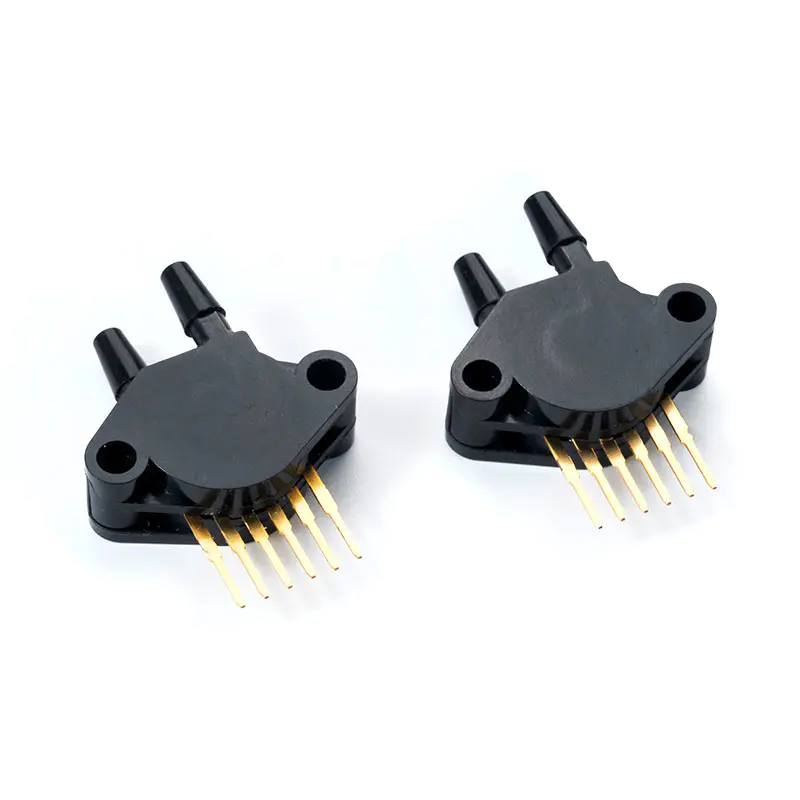
中文简体Direct Plug Package DIP/SIP Pressure Sensor Manufacturers
Direct insertion package (DIP) is a traditional form of integrated circuit packaging, in which pins are vertically led out from both sides of the package for easy insertion into through holes on the circuit board for soldering. It has high mechanical stability and electrical connection reliability, making it suitable for electronic devices that require frequent plugging and unplugging or work in harsh environments. The installation and debugging of DIP packaged chips are relatively simple, and it is still a commonly used packaging choice for electronic products that require high circuit stability and small batch sizes, such as industrial control boards, testing equipment, etc.
SIP encapsulation, on the other hand, involves the pins being vertically led out from one side of the encapsulation and installed onto the circuit board using a direct insertion method. Compared with DIP, SIP packaging saves more lateral space on the circuit board and is suitable for applications with limited space but low requirements for vertical space. SIP encapsulation is commonly used in some simple integrated circuits, such as logic chips, small capacity memory, etc.
Mems
Wuxi Mems Tech Co., Ltd.
Founded in 2011 and located in Wuxi National Hi-tech District—China’s hub for IoT innovation. We are China Direct Plug Package DIP/SIP Pressure Sensor Manufacturers and Custom Direct Plug Package DIP/SIP Pressure Sensor Exporter, Company. MemsTech is enterprise specializing in the R&D, production, and sales of MEMS pressure sensors.Our sensor products are widely used in medical, automotive, and consumer electronics sectors. With professional development, scientific production management, rigorous packaging and testing, and competitive pricing, we consistently deliver high-performance, cost-effective sensing solutions.
News
-
Understanding Medium Pressure Sensors A Medium Pressure Sensor is a precision sensing device designed to measure pressure levels that fall between low-pressure and high-pressure ranges. These sensors are widely used in systems where stable, accurate pressure monitoring is essential but extreme pressure resistance is no...
VIEW MORE
-
Pressure sensing is a fundamental capability that bridges the physical and digital worlds, enabling everything from weather forecasting to life-saving medical interventions. Among the various types, the absolute pressure sensor holds a unique and critical position. But what exactly sets it apart? Unlike sensors that me...
VIEW MORE
-
In the rapidly evolving landscape of modern engineering and electronic design, the demand for precise, reliable, and compact sensing solutions is at an all-time high. Among the myriad of technologies available, the MCP Pressure Sensor has emerged as a critical component for a wide array of applications, ranging from in...
VIEW MORE
Direct Plug Package DIP/SIP Pressure Sensor Industry knowledge
How does temperature compensation affect the accuracy of a Direct Plug Package DIP/SIP Pressure Sensor?
In precision measurement and control systems, accuracy is the defining standard of a sensor's performance. Among various factors influencing measurement accuracy, temperature compensation plays a crucial role—particularly in applications exposed to dynamic environmental conditions. A direct plug package DIP/SIP pressure sensor is widely used in industrial automation, medical equipment, automotive systems, and smart home devices where the operating environment often experiences significant temperature fluctuations.
Founded in 2011 and located in Wuxi National Hi-tech District, Wuxi Mems Tech Co., Ltd. has become a specialized enterprise in the R&D, production, and sales of MEMS pressure sensors. The company's expertise in temperature compensation technology ensures consistent and reliable performance across a wide temperature range. With applications extending from hydraulic systems to medical monitoring devices, the firm's direct plug package DIP/SIP pressure sensors demonstrate how proper thermal management directly enhances sensor accuracy and long-term stability.
Understanding the structure of a direct plug package DIP/SIP pressure sensor
DIP and SIP packaging principles
A direct plug package DIP/SIP pressure sensor derives its name from its encapsulation and connection method. The dual in-line package (DIP) features two rows of pins extending perpendicularly from both sides of the package, allowing the sensor to be inserted directly into circuit board holes and soldered securely. This design offers strong mechanical stability and excellent electrical contact reliability, making it suitable for industrial control systems and testing equipment that demand frequent handling or exposure to vibration.
In contrast, the single in-line package (SIP) uses a single row of vertically aligned pins on one side. While it provides similar insertion convenience, SIP encapsulation offers better space efficiency, which is ideal for applications with limited board area but moderate height clearance. In both packaging forms, the direct plug design ensures easy installation, stable connectivity, and efficient debugging, simplifying integration into existing system architectures.
How temperature affects pressure sensor accuracy
Pressure sensors rely on the conversion of mechanical stress into an electrical signal. In a direct plug package DIP/SIP pressure sensor, the sensing element—typically a MEMS-based piezoresistive chip—responds to applied pressure by changing its resistance. This change is then translated into an output voltage or digital signal.
However, temperature variations can distort these electrical characteristics in several ways:
- Material expansion and contraction – Variations in temperature alter the physical dimensions of the sensor's diaphragm and substrate, slightly modifying the strain distribution and leading to output shifts.
- Resistance drift – The resistive elements within MEMS structures exhibit temperature-dependent changes in resistance, introducing offset errors in the output signal.
- Zero-point and span shift – These are among the most common sources of inaccuracy; the sensor's zero output and full-scale output values shift as temperature changes.
- Thermal stress mismatch – Different materials used in packaging, solder, and silicon have varying coefficients of thermal expansion. Uneven stress accumulation can affect the linearity and long-term stability of the sensor.
Without effective temperature compensation, even a high-quality MEMS pressure sensor can display noticeable temperature drift, compromising its precision and repeatability.
The principle of temperature compensation
Temperature compensation refers to the process of correcting a sensor's output to minimize the influence of temperature fluctuations on measurement accuracy. In the direct plug package DIP/SIP pressure sensor, this involves both hardware and software strategies.
Hardware compensation
Hardware-based temperature compensation uses additional circuitry or materials with counteracting temperature coefficients to stabilize output. Precision resistors, thermistors, or specialized bridge balancing networks can adjust the signal path dynamically.
Software compensation
Software-based techniques use microcontrollers or calibration algorithms to correct data based on temperature readings collected during operation. Through mathematical modeling and real-time correction, these systems effectively linearize the sensor's output over the full temperature range.
At Wuxi Mems Tech Co., Ltd., all products undergo zero/full-scale calibration, temperature drift testing, and long-term stability evaluation before shipment. This ensures every direct plug package DIP/SIP pressure sensor maintains accurate performance even under rapidly changing thermal conditions.
Temperature compensation and calibration process
The temperature compensation process involves several stages designed to establish stable output behavior across the full temperature range.
1. Characterization
Sensors are first tested under controlled conditions to record how their outputs vary across multiple temperatures. Data points are collected from sub-zero to elevated temperatures to build an error profile.
2. Modeling
Based on this data, engineers develop compensation models that describe the relationship between temperature and output deviation.
3. Implementation
These models are implemented through either analog circuitry (e.g., resistive balancing networks) or digital control (e.g., microcontroller-based compensation).
4. Verification
Each direct plug package DIP/SIP pressure sensor is re-evaluated after compensation to confirm that the output remains within specified accuracy limits, typically ±1.5% VFSS for standard series and up to ±1.0% for high-precision versions.
Impact of temperature compensation on sensor accuracy
Temperature compensation significantly improves the accuracy, stability, and lifespan of a direct plug package DIP/SIP pressure sensor. The effects can be summarized in the following table:
| Performance Aspect | Without Temperature Compensation | With Temperature Compensation |
|---|---|---|
| Output Stability | Output drifts under temperature change, causing offset errors | Output remains consistent across wide temperature range |
| Zero-point Accuracy | Shifts significantly due to thermal expansion and resistance variation | Maintains stable zero offset across calibrated range |
| Span Accuracy | Full-scale output varies with temperature | Calibrated for uniform output at all temperatures |
| Long-term Reliability | Accelerated degradation due to thermal stress | Improved stability through balanced stress management |
| Measurement Repeatability | Inconsistent readings during continuous operation | High repeatability even under fluctuating conditions |
Through this process, compensated sensors deliver stable and precise measurements critical to industrial automation, medical monitoring, and automotive control systems.
Temperature compensation in industrial applications
In industrial automation, machinery often operates under fluctuating thermal conditions due to high power consumption and environmental exposure. Systems such as hydraulic pumps, air compressors, and pneumatic equipment require sensors that can maintain accurate pressure readings despite temperature variations.
A direct plug package DIP/SIP pressure sensor with full-range temperature compensation ensures stable output signals, enabling precise control loops and reducing downtime caused by sensor recalibration. Wuxi Mems Tech Co., Ltd. integrates anti-interference design and temperature drift correction within its industrial-grade sensors, supporting consistent monitoring in harsh environments.
The result is enhanced system reliability, reduced maintenance frequency, and optimized process efficiency—key factors in modern manufacturing automation.
Temperature compensation in medical devices
Temperature control is critical in medical systems, where even minor sensor inaccuracies can impact patient safety. Devices such as ventilators, infusion pumps, and blood pressure monitors depend on stable pressure detection across wide environmental ranges.
Compensated direct plug package DIP/SIP pressure sensors provide low-drift performance, ensuring that readings remain accurate during long-term operation. The sensors designed by Wuxi Mems Tech Co., Ltd. offer fast response, compact size, and high repeatability, allowing integration into complex medical circuits.
For medical device engineers, temperature-compensated sensors simplify system calibration and maintain accuracy even under variable room or body temperatures, ensuring reliable diagnostic and therapeutic outcomes.
Temperature compensation in automotive environments
Automotive systems are exposed to some of the most extreme operating conditions—ranging from freezing winters to engine-compartment heat exceeding 100°C. In this environment, direct plug package DIP/SIP pressure sensors play vital roles in fuel control, braking systems, and emission monitoring.
Effective temperature compensation ensures the sensors provide consistent readings despite these fluctuations. Wuxi Mems Tech Co., Ltd. offers automotive-grade MEMS pressure sensors that maintain ±1.0% accuracy from -40°C to 150°C, ensuring precision across the full vehicle operation range.
Such stability contributes to better fuel efficiency, improved safety, and extended engine lifespan, highlighting the indispensable role of thermal compensation in modern automotive electronics.
Temperature compensation in consumer electronics
As consumer products evolve toward miniaturization and smart connectivity, direct plug package DIP/SIP pressure sensors are increasingly integrated into compact systems like smart toilets, water purifiers, robotic vacuum cleaners, and air purifiers.
These devices demand quick pressure response and consistent accuracy in various household temperature conditions. Sensors with full-process temperature compensation enable precise control of air or water flow, contributing to both energy efficiency and enhanced user experience.
By supporting analog and digital interfaces such as I²C communication, the sensors easily integrate into diverse product architectures, providing flexibility for smart home manufacturers aiming to optimize functionality and cost.
Manufacturing control and quality assurance
At Wuxi Mems Tech Co., Ltd., the precision of each direct plug package DIP/SIP pressure sensor is maintained through a standardized production line with complete in-house capabilities, including packaging, soldering, temperature calibration, and full-process testing.
Every product is subjected to zero/full-scale calibration and long-term stability evaluation, ensuring consistency across production batches. The 2,000 m² manufacturing facility enables volume production while maintaining strict ISO quality compliance and RoHS standards.
This rigorous manufacturing discipline ensures that temperature-compensated sensors not only achieve superior initial accuracy but also retain stability over extended operational lifetimes.
Why temperature compensation defines sensor quality
The accuracy of a direct plug package DIP/SIP pressure sensor is inseparable from its ability to handle temperature variations effectively. Compensation ensures:
- Consistent signal output across a wide range of environmental conditions.
- Extended operational lifespan due to reduced thermal stress.
- Improved product reliability in demanding industries.
- Reduced recalibration costs and system downtime.
Ultimately, temperature compensation transforms the sensor from a component into a precision measurement instrument, capable of supporting critical applications where even small deviations could compromise performance.
Conclusion
Temperature compensation is the cornerstone of pressure sensor performance. In a direct plug package DIP/SIP pressure sensor, it ensures that mechanical precision is matched by thermal stability, enabling accurate, repeatable, and reliable data output under diverse operating conditions.
The approach adopted by Wuxi Mems Tech Co., Ltd.—from advanced MEMS design and thorough calibration to rigorous testing and process control—demonstrates the company's dedication to achieving consistent accuracy across applications. Whether in industrial automation, medical devices, automotive systems, or smart consumer electronics, these compensated sensors maintain stability where precision matters most.
By integrating comprehensive temperature compensation into every production stage, the direct plug package DIP/SIP pressure sensor delivers dependable measurement performance, meeting the increasing demands of modern intelligent systems and ensuring a balance between accuracy, durability, and adaptability.

Mems Tech has specialized in the field of pressure sensors for over 14 years.
Quick
Product Categories
Contact Us
-
 [email protected]
-
 +86-18068257393
-
 50-1125 Zhongbang City Garden, No.2008 Taihu East Avenue, Xinwu District, Wuxi City, Jiangsu Province, China
Wuxi Mems Tech Co., Ltd.
Copyright © 2025 byWuxi Mems Tech Co., Ltd. Rights Reserved.
Custom Direct Plug Package DIP/SIP Pressure Sensor Manufacturers
